Society
Initiatives for Respecting Human Rights
The Aisan Group supports international standards such as the United Nations' Guiding Principles on Business and Human Rights, and acknowledges the importance of respecting human rights from the standpoint of sustainable growth and medium- to long-term improvement in corporate value. Against this backdrop, we will continue to work on human rights initiatives within the framework of "Achieving harmony with the local community and contributing to a sustainable society," one of the materialities (key issues) we identified based on our Sustainability Fundamental Policy.
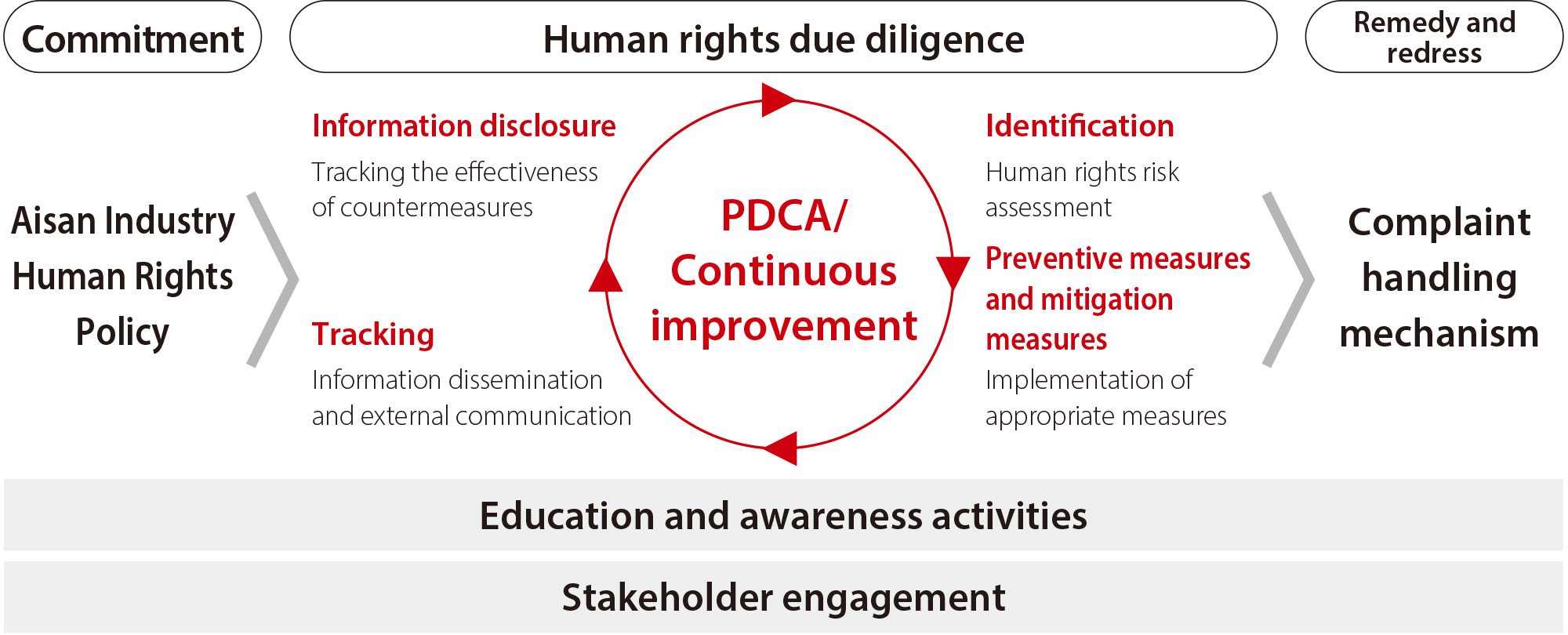
Aisan Industry Human Rights Policy
The Aisan Group established its Human Rights Policy on August 29, 2022.
We apply this policy to executives and employees across the entire Aisan Group, and will continue to engage in dialogue with all stakeholders including business partners, working in tandem to promote human rights initiatives based on this policy.
Scope of human rights issues covered by the Aisan Industry Human Rights Policy
- Risks on key human rights and business-related human rights that companies should consider (26 items) within the Japanese government’s
- National Action Plan on Business and Human Rights, compliance adherence, and social issues for coexistence with local communities
Promotion System
In April 2022, we established the Sustainability Committee to conduct comprehensive management reviews on the direction and appropriateness of ESG initiatives by executive management in accordance with the Sustainability Fundamental Policy. In July 2025, in order to address changes in the external environment and rationalize internal operations, we reviewed the structure and operational flow of this meeting body to render it more efficient and functional.
The Head of Human Resources Infrastructure has oversight over the Group’s human rights initiatives, and the Corporate Planning Department (legal, external relations, and public relations), Human Resources Department (employees), and Purchasing Planning Division (suppliers) work in tandem to pursue these initiatives under the jurisdiction of the General Administration Department. Management reviews of these initiatives are conducted by a People Empowerment Promotion Meeting, comprised of members put forward by each department, and results are conveyed to the Board of Directors via the Sustainability Committee.
Human rights due diligence
Prior to pursuing initiatives based on our Human Rights Policy, we practice human rights due diligence in accordance with the United Nations' Guiding Principles on Business and Human Rights.
We utilize internal questionnaires and evaluation items from the Ministry of Justice and external evaluation organizations to identify salient human rights issues affecting the Aisan Group, thereafter prioritizing their implementation.
(1) Identification
Human rights risk assessment
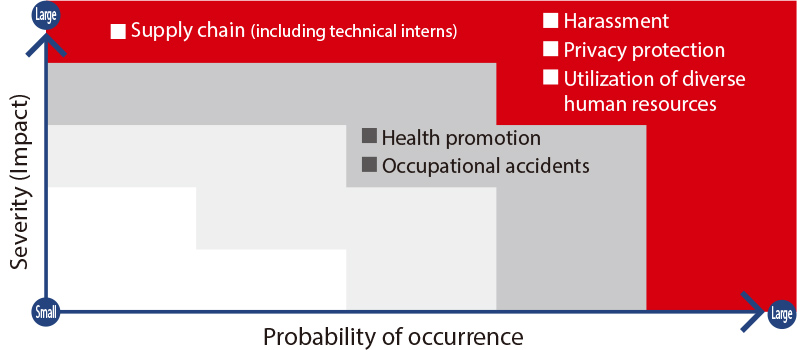
Salient human rights issues
| Priority points | Initiatives |
|---|---|
| Harassment | Through training programs, including compliance education, we will build an environment where every employee can work with peace of mind |
| Privacy protection | We will promote awareness activities not only regarding the handling of personal information but also concerning the handling of factual information related to private life |
| Participation of diverse human resources | We will embed DEI and build a workplace environment where everyone can actively participate at work |
| Supply chain (including technical interns) |
We will visit suppliers and advance human rights initiatives together through dialogue |
(2) Preventive measures and mitigation measures
In order to avoid, prevent, and mitigate human rights violations, we have taken the following steps to address salient human rights issues.
Harassment
We hosted “Human Rights Management x Diversity Education” and “Compliance Education” sessions at each plant to raise employee awareness of these subjects. Through these sessions, participants gained a deeper understanding of Aisan Industry Human Rights Policy and the human rights issues affecting daily operations.
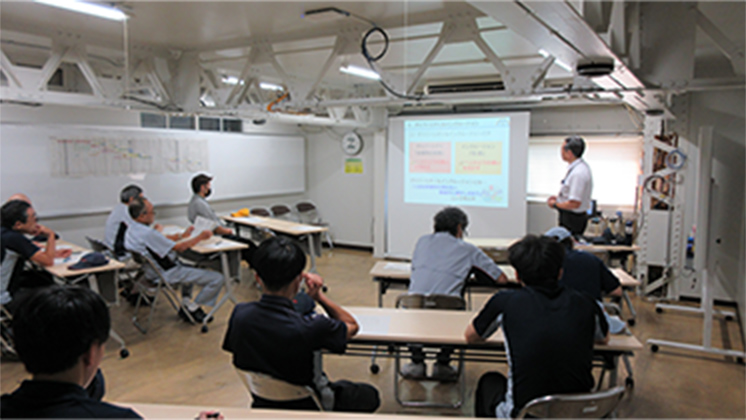
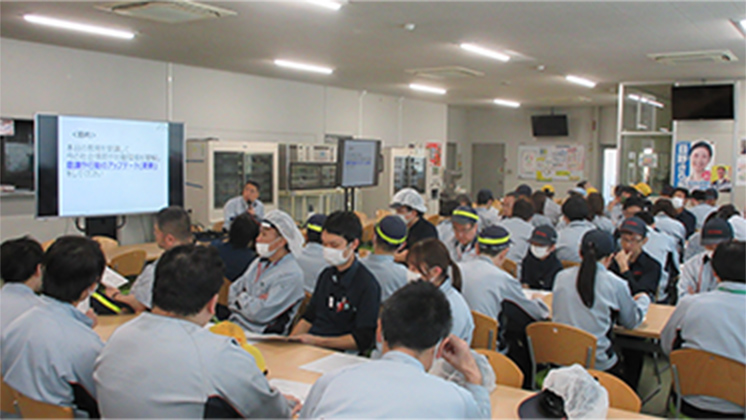
Human Rights Management x Diversity Education
Number of participants: 935
Privacy protection
We utilize our internal newsletter to disseminate information on risks among all employees, in order to heighten awareness and strengthen preventive measures.
Participation of diverse human resources
We held “Unconscious Bias Training” for managers to aid in recognizing and understanding the impact of workplace unconscious bias.
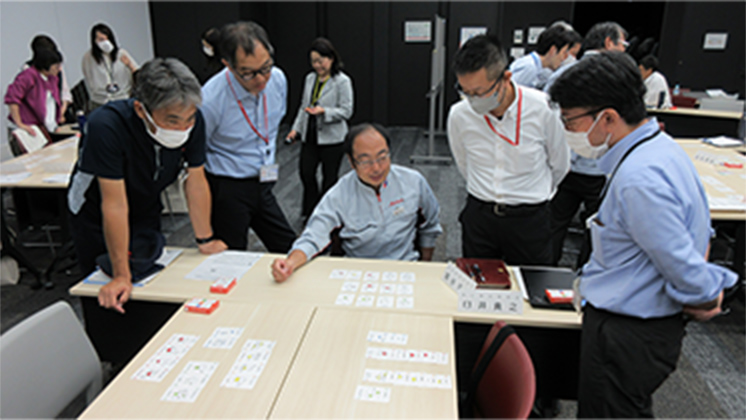
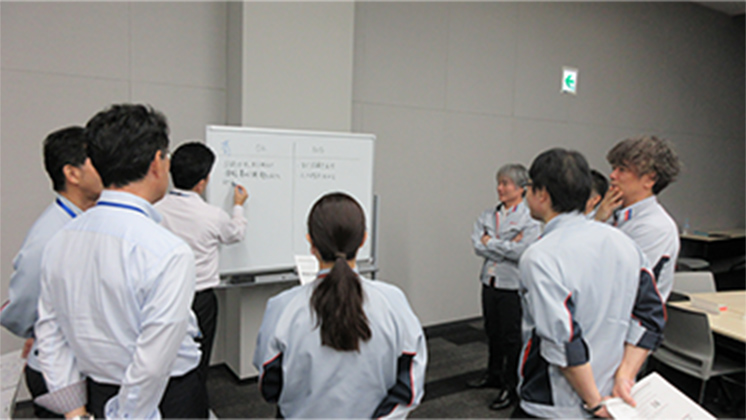
Unconscious Bias Training
Number of participants: 117
Supply chain
We distributed our "Supplier Sustainability Guidelines" and "Sustainability Checklist" to suppliers, visiting them to gauge current circumstances and share information on human rights issues, including those pertaining to technical intern trainees. During these visits, we assessed the daily activities of production site employees and also examined the employment status of technical intern trainees, if present.
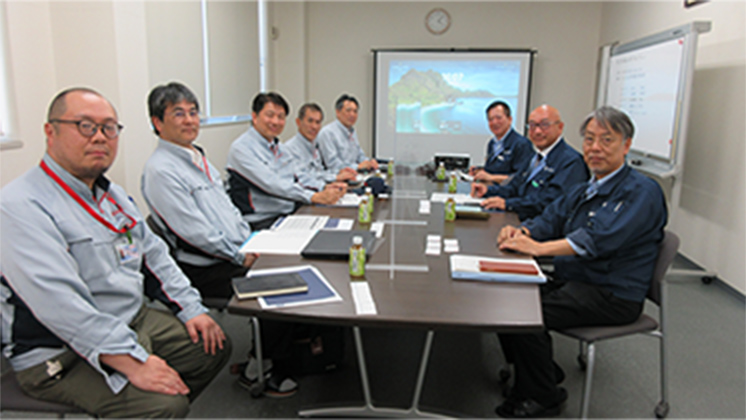
Number of suppliers visited: Four
(3) Tracking
We implemented an e-learning program for employees to ensure respect for human rights.
| FY2024 | FY2025 | |
|---|---|---|
| Understanding of Human Rights Policy | 54% | 80% |
| Understanding access to remedies | 42% | 88% |
| Understanding human rights issues | - | 89% |
We distributed a questionnaire within the Company and analyzed the results, using our findings as basis for an internal education program to deepen understanding of human rights and compliance. We also regularly disseminated information via our internal newsletter and Company portal, successfully enhancing employee awareness and understanding of each issue.
(4) Information disclosure
We communicated results from the e-learning program to all employees via the company newsletter. In this manner, we seek to deepen understanding of human rights issues by sharing employees’ general level of understanding, using our findings to review the e-learning curriculum, and periodically disseminating information.
Complaint handling mechanism
We have internal and external grievance mechanisms accessible to employees and stakeholders, respectively.
In order to provide whistleblower protection, our internal regulations specifically permit anonymous consultations and reporting, and stipulate that whistleblowers should not be treated unfairly.
Reports submitted via these grievance mechanisms are dealt with appropriately via the Company’s whistleblowing response flow (in accordance with the Whistleblower’s Protection Act).
Incidence of human rights violations
The number of reports submitted via these grievance mechanisms increased year on year in FY2024, due in part to ongoing compliance education and awareness-raising activities. However, internal investigations guided by the Company’s whistleblowing response flow found no instances of human rights violations with a major impact. Where instances of human rights violations were uncovered, they were dealt with in a timely and appropriate manner consistent with the circumstances.
To prevent recurrence, instances of human rights violations are reflected in the Company’s compliance and harassment training and educational tools.
Creating a good workplace culture (through education and awareness-raising activities)
We conduct human rights education and lectures to foster a workplace culture that enables all employees to “know, learn, and act” with regard to human rights in general.
We also endeavor to continuously raise awareness by disseminating information via the Company’s internal newsletter.
Human rights education and awareness-raising activities
| Education | Target | Aim | Attendance rate |
|---|---|---|---|
| Lectures on respect for human rights | Interested individuals | Inviting guest lecturers to raise employees’ human rights awareness | ー |
| Rank-based education and education for newly appointed officers | Eligible individuals | Education required by each rank (on harassment, etc.) | 100% |
| Education for new employees and career employees | New employees | Raising awareness of human rights and preventing violations | 100% |
| Raising awareness through Ethics Month | All employees | Promoting human rights awareness via e-learning, etc. | ー |
Lectures on respect for human rights
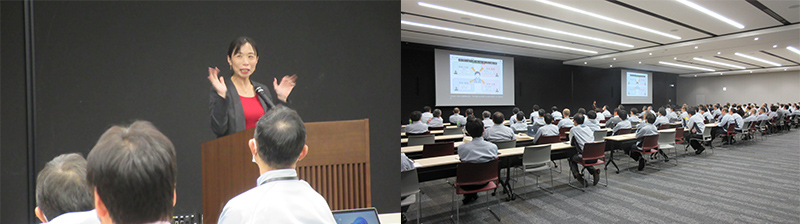
Since formulating our Human Rights Policy, we have been inviting guest lecturers to speak on International Human Rights Day, with a view to enhancing employees’ familiarity with human rights and fostering a culture in which employees can show consideration for others.
- Participation in the human rights lectures is also open to Group companies in Japan and the Aikyokai association of suppliers.
| FY | Theme | Lecturer | Goal |
|---|---|---|---|
| ‘22 | Business and Human Rights Responses Required of Companies Today | Nagoya Legal Affairs Bureau | Understanding management respect for human rights and identifying issues |
| ‘23 | A Simple Lecture on Human Rights: A Human Rights Tale Filled with Tears and Laughter |
Rakugo storyteller Unpei Hayashiya |
Learning the importance of familiarity with, and respect for, human rights |
| ‘24 | Balancing Work and Care: The Connection Between Human Rights and Caregiving |
Mie Waki, founder of Work and Care Balance Laboratory | Learning about the connection between human rights and caregiving, and determining how the former should inform the latter |
Number of lecture participants
| FY2022 | FY2023 | FY2024 | |
|---|---|---|---|
| Participants | 64人 | 417人 | 387人 |
- Shows only participants on the day
Lecture on respect for human rights
Held on December 11, 2024
Stakeholder Engagement
In order for the company to conduct its business activities and achieve long-term, stable enhancement of corporate value, it is essential to build good relationships of trust with stakeholders.
We have established a framework for taking the opinions and concerns heard through dialog with stakeholders and appropriately reflecting these in management decisions, maintaining transparency in our information disclosure and ensuring accountability. Furthermore, we listen sincerely to our stakeholders and consistently communicate with them as we seek to identify major human rights issues specific to the industry. Once these issues are identified, we work with the parties involved to take corrective action and precautionary measures.
Primary means of communication
| Stakeholders | Primary means of communication |
|---|---|
| Employees | Labor-management discussions, labor-management council meetings |
| Domestic Group companies | Human resources & Labor Affairs Committee for Group companies in Japan |
| Overseas group companies | Meetings of overseas location heads |
| Suppliers | Procurement policy briefings |
| Customers | Policy briefings, expectation-alignment meetings |
| Shareholders and investors | General shareholders’ meetings, information disclosure (integrated reports, etc.), briefings for securities analysts and institutional investors |
| Local communities | Invitations to Company events, participation in community events, informal community meetings |
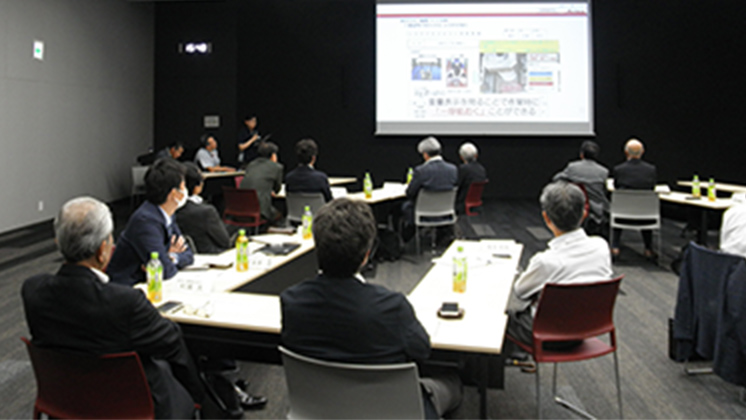
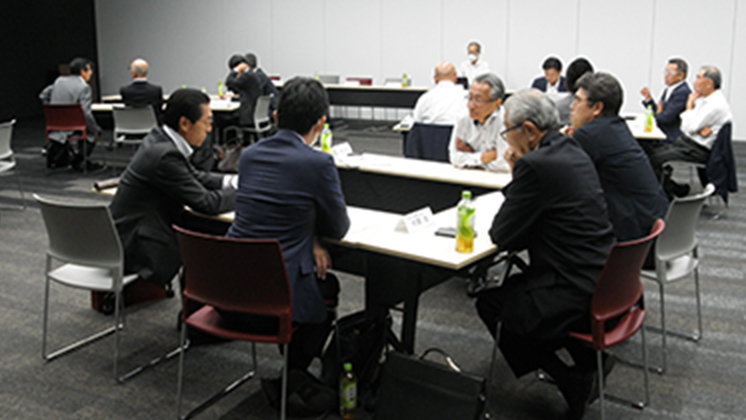
Training for leaders of Aikyokai association of suppliers
The training enabled participants to deepen their understanding of each other through group discussions regarding the Company’s human rights management and diversity initiatives, and individual supplier initiatives.