
Environment
Information Disclosure Based on the TCFD Recommendations
Information Disclosure Based on the TCFD Recommendations
In recent years, global decarbonization has accelerated, with a view to achieving the 1.5°C target set forth in the Paris Agreement. In Japan as well, under its energy policy, decarbonization in combination with a stable energy supply and economic growth is required, making addressing climate change an important management issue for companies.
Recognizing climate change as a critical management issue in light of this business environment, Aisan Group announced its support for the Task Force on Climate-related Financial Disclosures (TCFD) in May 2022. Since then, based on TCFD's recommendations, we have been analyzing the impact of climate change on our business activities and medium- to long-term corporate value from both the perspectives of risks and opportunities, and taking measures to address these issues.
Going forward, the Group will continue to improve the effectiveness of its climate change initiatives and enhance disclosure in line with the TCFD recommendations, aiming to achieve sustainable business growth and increase corporate value.
Governance
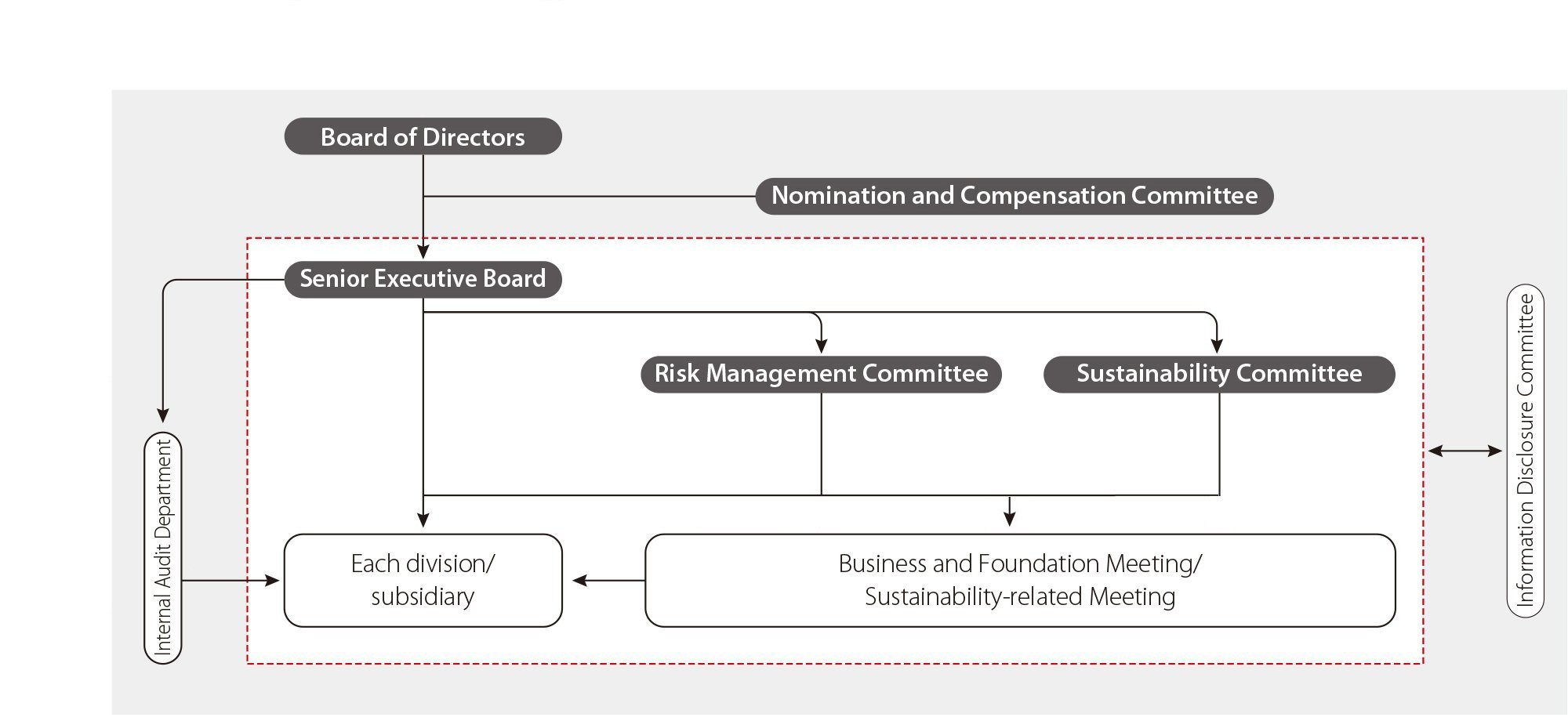
The Sustainability Committee, which is chaired by the CRO*, verifies the direction and its appropriateness related to all issues concerning sustainability, including climate change. In addition, the Carbon Neutral Promotion Meeting (meetings held at least once every three months), which is a subcommittee of the Sustainability Committee, formulates, executes, and manages plans related to the climate change issue.
At the Sustainability Committee meetings held twice a year, we receive reports from the Carbon Neutral Promotion Meeting, the People Empowerment Promotion Meeting, and the Governance Meeting, and deliberate on their contents. Among the results of these deliberations, important matters, including those related to climate change, are reported to the Board of Directors and the Senior Executive Board at least once a year and are subject to oversight by the Board of Directors.
- CRO: Chief Risk Officer
FY 25 Results and Main Agenda
| Board of Directors | Sustainability Committee | Carbon Neutral Promotion Meeting | |
|---|---|---|---|
| Number of meetings* | 1 meetings | 3 meetings | 4 meetings |
| Agenda |
|
|
|
- Number of meetings: Number of meetings in which climate change-related matters were discussed.
Strategy
Premises for Scenario Analysis
The Aisan Group has conducted scenario analysis on the group-wide (consolidated) impact of vehicle electrification as a turning point in 2030 and the impact of the carbon-neutral target for 2050. Scenario analysis was performed using several scenarios (1.5°C/2°C and 4°C) to enhance sustainable competitiveness by appropriately responding to an uncertain future. For these scenarios, references included the International Energy Agency’s World Energy Outlook 2024 for transition risks, and the Intergovernmental Panel on Climate Change (IPCC) Sixth Assessment Report for physical risks.
| 4°C scenario | 1.5°C/2°C scenario | ||
|---|---|---|---|
| Assumed World |
Expansion of physical risks
|
Expansion of transition risks
|
|
| Representative scenarios | Transition Risks |
|
|
| Physical Risks |
|
|
|
- SSP:Shared Socio-economic Pathways
Societal assumptions in the scenarios
In the 1.5°C/2°C scenario, we anticipate the implementation of more sophisticated policies and legal systems aimed at the decarbonization of society, including the introduction of carbon taxes and the strengthening and stricter enforcement of greenhouse gas emissions restrictions. In the automotive industry, we expect to see stronger and more stringent calls for the reduction of CO₂ emissions throughout the product life cycle, which spans the raw materials stage through vehicle operation and on to end-of-life disposal, in addition to emissions during the manufacturing process. Consequently, the market shares of battery electric vehicles (BEVs), plug-in hybrid electric vehicles (PHEVs), and fuel cell vehicles (FCVs) are expected to rise.
Meanwhile, in the 4°C scenario, we assumed that, as global warming progresses, natural disasters will become more frequent severe, and prolonged, resulting in supply chain disruptions, temporary halts of production, and other impacts.
Risks and opportunities expected due to climate change
Based on scenario-driven social perspectives, Aisan Group has mapped out its risks and opportunities considering both stakeholder and company significance. Risks and opportunities were identified considering country/region situations and business context, with a long-term time frame up to 2050. For items considered particularly important, we evaluated the financial impact in 2030 and are responding to mitigate risks and create opportunities.
Risks/opportunities and response to climate change
| Category | Details | Timescale | Impact level | Aisan Group’s response | ||
|---|---|---|---|---|---|---|
|
Transition risk
|
Policy / Regulation
|
GHG Emission Regulations | Increase in manufacturing costs due to strengthened energy policies and use of renewable energy | Medium to long-term | Medium |
|
| Introduction of carbon tax |
Increase in production costs due to carbon tax introduction | Medium to long-term | Medium |
|
||
| Increase in procurement costs through carbon tax price transfer | Medium to long-term | Large |
|
|||
|
Technology
|
Expanding demand for low- and decarbonized products | Delayed recovery of investment costs due to slow transition to new areas | Medium to long-term | Medium |
|
|
|
Market
|
Changes in customer values | Decreased sales of engine parts due to increased BEV adoption *1 | Medium to long-term | Large |
|
|
|
Reputation
|
Insufficient environmental initiatives or disclosure | Decreased corporate value Decrease in customer trust |
Medium to long-term | Medium |
|
|
|
Physical risk
|
Acute
|
Increased frequency and severity of natural disasters Longer duration | Temporary production suspension due to supply chain disruption | Medium to long-term | Medium |
|
|
Opportunity
|
Technology
|
Acceleration of electrification and industry restructuring | Increased market share of key products | Up to medium-term | Large |
|
|
Market
|
Expansion and development of low-carbon products | Increased revenue from hydrogen supply units as hydrogen energy use expands | Medium to long-term | Medium |
|
|
| Increased opportunities for entry into electrified product markets due to more BEVs/PHEVs/FCEVs*1 | Medium to long-term | Large |
|
|||
| Expansion of business opportunities in new carbon neutral fields | Medium to long-term | Small |
|
|||
| Increased demand for products contributing to emission reductions | Medium to long-term | Medium |
|
|||
[Timescale] Short-term:through 2026; Medium-term:through 2030; Long-term:through 2050
[Impact level] Impact on single-year operating profit:
Large, 2.0 billion yen or more; Medium, 0.1 billion yen to less than 2.0 billion yen; Small, less than 0.1 billion yen
[Aisan Group’s response] We have incorporated plans for decarbonization and initiatives for mitigating risks and creating opportunities related to climate change in the Medium-term Management Plan announced in February 2025 and are promoting activities accordingly.
- Assumption of the number of units is calculated based on the 2℃ scenario
- FFV: Flexible-Fuel Vehicle
Financial Impact
[1.5°C Scenario / Below 2°C Scenario: Transition toward a decarbonized society]
The estimated financial impact (risk) in 2030, due to factors such as cost increases from implementation of a carbon tax and decreased sales of engine parts, would be about 21 billion yen.On the other hand, the estimated positive impact (opportunity) of expansion/development of low-carbon products and industry reorganization due to accelerated electrification in 2030 would be about 23 billion yen.
[4°C Scenario: Global Warming Accelerates]
The estimated financial impact (risk) in 2030 from the increasing frequency and severity of natural disasters is approximately 0.6 billion yen*1.
- Non-consolidated
Risk Management
In addition to receiving reports from the Carbon Neutral Promotion Meeting on climate change risks that significantly impact management, the Risk Management Committee of the Aisan Group periodically reviews key risks by collecting opinions from risk owners representing various departments. Additionally, the committee enhances the sharing of incident information, evaluates risk response status, and reports to the Board of Directors as necessary. The Board of Directors oversees the Risk Management Committee, provides necessary guidance and advice, and reviews the effectiveness of its processes at least once a year. Furthermore, should risks materialize, we have established a system to promptly set up a countermeasures headquarters and respond to incidents based on the CRO’s instructions.
Indicators and Targets
In light of the external environment, under our company's Medium-Term Management Plan (2025-2030), we formulated a transition plan to address climate change risks, towards the realization of a sustainable recycling-based society, and are working to reduce greenhouse gas emissions through carbon-neutral-related investments utilizing internal carbon pricing (ICP). In addition, as a stepping stone to new fields and future products, we will advance all forms of energy mobility and contribute to solving social issues in areas beyond mobility.
Carbon neutral target (FY2030)
| Challenges | Item | Target |
|---|---|---|
| Carbon neutral | Scope 1 & 2 | -60% compared to FY2019 |
| Scope 3 | -28% compared to FY2019 | |
| Renewable energy ratio | 55% | |
| Energy creation ratio | 5% | |
| Circular economy | Zero-waste emissions | -5% compared to FY2019 (intensity) |
| Nature positive | Water usage | -5% compared to FY2019 (intensity) |